Meal Prep for Fat Loss
What to Eat, How Much, and Why Precision Beats Willpower Every Time
Part 4 of the Specimen Training Meal Prep Series
You have tried losing weight before. You already know discipline is not your problem.
You negotiate multi-million dollar contracts. You lead organizations. You operate under pressure that would sideline most people. Discipline is not something you lack.
What you lack is a system.
Consider this: your brain makes up only 2 percent of your total body weight. Yet it consumes roughly 20 percent of your body's entire resting energy supply, used almost entirely to sustain continuous electrical signaling and maintain cell health. It is the most metabolically expensive organ you own.
And it is running on whatever you last ate.
Fat loss for a high achiever is not a motivation problem. It is a precision problem. Without a structured approach to what you eat and how much, even the most disciplined person in the room ends up in the same cycle: eating well for a stretch, traveling or hitting a brutal work week, losing the thread, and starting over.
Meal prep is the system that ends that cycle. Not because it requires more willpower, but because it requires less. When the right food is already made, the decision is already made. And that is where fat loss actually lives: in the decisions you do not have to fight your way through.
Why Fat Loss Stalls for High Achievers Specifically
Before we build the solution, it is worth naming the actual problem. Because fat loss stalls for high achievers in specific, predictable ways that most generic nutrition advice completely ignores.
Invisible Calories from Convenience
Restaurant meals, catered lunches, client dinners, and grab-and-go food are the default nutrition environment for most attorneys and executives. The problem is not that these meals taste bad. The problem is that they are engineered to be calorie-dense, and portion sizes are almost always larger than what you would serve yourself at home.
One restaurant lunch can easily deliver 900 to 1,200 calories with minimal protein and high refined fat and sodium content. Multiply that by four or five times per week, and the calorie surplus compounds quietly in the background while you wonder why the scale is not moving.
Stress-Driven Cortisol and Stubborn Body Fat
Chronic professional stress keeps cortisol elevated for extended periods. Elevated cortisol triggers the body to preferentially store fat in the abdominal region, the exact area most high achievers want to address first. It also increases appetite, particularly for high-calorie, high-carbohydrate foods.
This is not a character flaw. It is a hormonal response. And meal prep addresses it directly by stabilizing blood sugar and reducing the cortisol spikes triggered by erratic eating patterns.
All-or-Nothing Thinking
High achievers are wired for excellence, which often translates into all-or-nothing behavior around food. The week goes perfectly until a work event derails one dinner, and suddenly the entire nutrition plan gets abandoned until Monday.
A meal prep system changes this dynamic. When four of your five weekday lunches are already handled, one off-plan meal is a minor detour, not a reason to start over. Consistency beats perfection every single time.
The Fat Loss Equation: What Actually Drives Results
Fat loss comes down to one non-negotiable principle: you must consume fewer calories than your body expends over time. That is the foundation. Everything else, timing, food quality, macros, supplements, is built on top of that foundation.
But how you create that calorie deficit matters enormously, especially for a high achiever who cannot afford to sacrifice cognitive performance, muscle mass, or sustained energy in the process.
Here is how the three pillars of the Performance Meal Formula from Post 3 apply specifically to fat loss:
High Protein Protects Muscle While You Lose Fat
This is the most critical piece of the fat loss puzzle that most people get wrong. When you are in a calorie deficit, your body will pull energy from both fat stores and muscle tissue unless protein intake is high enough to signal that muscle preservation is a priority.
Losing muscle is the worst possible outcome for a high achiever. Muscle is metabolically active tissue, meaning it burns calories at rest. Lose it, and your metabolism slows. Keep it, and your body becomes a more efficient fat-burning machine over time.
Target 0.8 to 1 gram of protein per pound of bodyweight per day during a fat loss phase. At 180 pounds, that is 144 to 180 grams of protein daily. Meal prep makes hitting that target effortless because your protein sources are already cooked, portioned, and ready.
Fiber Creates Satiety Without Excess Calories
Hunger is the primary reason fat loss attempts fail. When you are running a calorie deficit, your body will signal hunger. The goal is not to ignore those signals. The goal is to eat in a way that satisfies them without overshooting your calorie target.
Fiber-rich foods do this better than any other macronutrient. Vegetables, legumes, and whole grains take up significant volume in your stomach, digest slowly, and keep you full for longer periods relative to their calorie contribution. A large bowl of roasted broccoli with lean protein delivers satiety at a fraction of the calorie cost of a restaurant pasta dish.
Strategic Fat Intake Supports Hormones and Hunger Control
Dietary fat is calorie-dense at 9 calories per gram, compared to 4 calories per gram for protein and carbohydrates. During a fat loss phase, total fat intake should be moderate rather than eliminated. Dropping fat intake too low disrupts testosterone production, impairs joint health, and reduces the absorption of fat-soluble vitamins A, D, E, and K.
The key is choosing fats strategically. Avocado, olive oil, and a handful of walnuts deliver satiety and hormonal support without the calorie load of processed cooking oils or the hidden fats in restaurant food.
The Fat Loss Meal Prep Blueprint
Here is how to apply the Protein + Fiber + Fat formula specifically for fat loss. The adjustments are in the ratios and food choices, not in the fundamental structure.
The Fat Loss Plate Formula
• 50% of your plate: non-starchy vegetables (broccoli, spinach, peppers, zucchini, asparagus, Brussels sprouts)
• 30% of your plate: lean protein (ground turkey, chicken breast, egg whites, white fish, Greek yogurt)
• 20% of your plate: quality carbohydrate and fat (brown rice, sweet potato, quinoa, a drizzle of olive oil or quarter avocado)
This distribution keeps your calorie total controlled, your protein high enough to protect muscle, your fiber high enough to manage hunger, and your fat moderate enough to support hormonal health without blowing your deficit.
Best Proteins for Fat Loss Prep
During a fat loss phase, prioritize the leanest protein sources available. These deliver the highest protein per calorie, keeping your deficit intact while protecting lean mass:
• Ground turkey 93% lean — approximately 22 grams of protein per 3-ounce serving at around 130 calories
• Chicken breast — approximately 26 grams of protein per 3-ounce serving at around 120 calories
• Egg whites — approximately 17 grams of protein per half cup at around 77 calories
• White fish such as tilapia or cod — approximately 21 grams of protein per 3-ounce serving at around 90 calories
• Non-fat or low-fat Greek yogurt — approximately 17 grams of protein per 6-ounce serving at around 100 calories
Best Carbohydrates for Fat Loss Prep
Reduce portion size on starchy carbohydrates rather than eliminating them entirely. Cutting carbohydrates too aggressively impairs training performance and cognitive output. The goal is a controlled reduction, not elimination:
• Brown rice or quinoa, half-cup cooked serving rather than a full cup
• Sweet potato, one small or half a large
• Oats, half cup dry for breakfast
• Non-starchy vegetables in unlimited quantities: broccoli, spinach, zucchini, asparagus, peppers, cauliflower, green beans
The Hidden Calorie Traps That Stall Progress
Meal prep builds your foundation. But knowing what quietly undermines fat loss is equally important. These are the most common calorie traps for the high-achieving professional:
• Liquid calories. Specialty coffee drinks, smoothies with added sweeteners, alcohol, and even fruit juice carry significant calorie loads that do not register as satisfying food. A daily flavored latte can quietly add 200 to 400 calories without ever appearing on your nutritional radar.
• Cooking oils and sauces. A tablespoon of olive oil is 120 calories. Restaurant kitchens use four to six tablespoons on a single dish without mentioning it. Dressings, marinades, and sauces are among the most consistent sources of invisible calories in a professional's diet.
• Mindless snacking between meals. Not the strategic bridge snack discussed in Post 2, but the unconscious handful of nuts, the chips at a client meeting, the leftover pastry in the break room. These incidents rarely feel like eating but accumulate into hundreds of unaccounted calories daily.
• Oversized protein portions. Even healthy food in excess creates a calorie surplus. A six-ounce chicken breast is approximately 180 calories. A twelve-ounce restaurant portion is closer to 360. Prepping and portioning your own protein eliminates this variable entirely.
A Full Day of Fat Loss Meal Prep: What It Looks Like in Practice
Here is a sample fat loss day built entirely on prepped food, using the formula and plate blueprint from this post:
Morning: High-Protein Scramble
• 2 whole eggs plus 3 egg whites scrambled in a teaspoon of olive oil
• Half cup of oatmeal with a handful of blueberries
• Black coffee or green tea
Approximate calories: 380 to 420 | Protein: 32 to 36 grams
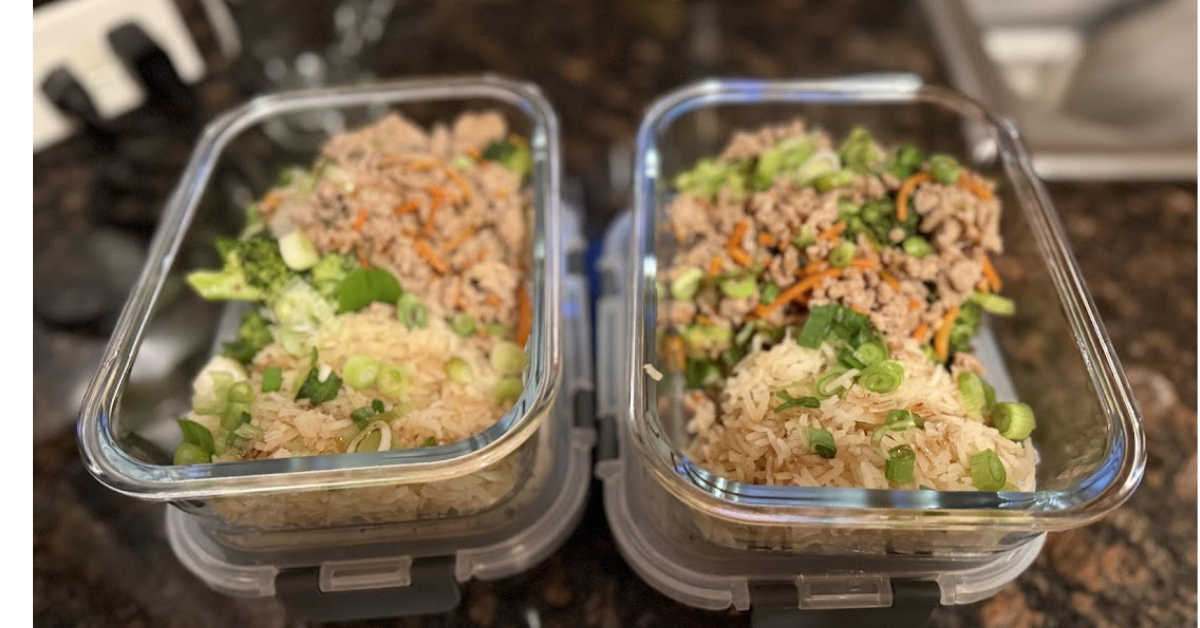
Midday: The Fat Loss Performance Bowl
• 5 ounces ground turkey or chicken breast, batch cooked
• Half cup brown rice or quinoa
• 1.5 cups steamed or roasted broccoli, peppers, or mixed vegetables
• Light drizzle of sesame oil or low-sodium soy sauce for flavor
Approximate calories: 420 to 470 | Protein: 38 to 44 grams
Afternoon Bridge Snack (if needed):
• 6 ounces plain Greek yogurt with a small handful of blueberries
Approximate calories: 130 to 150 | Protein: 16 to 18 grams
Evening: Sheet Pan Chicken and Vegetables
• 6 ounces chicken breast or white fish, baked or roasted
• 2 cups mixed roasted vegetables: asparagus, zucchini, broccoli
• Quarter avocado or a tablespoon of olive oil
Approximate calories: 400 to 440 | Protein: 42 to 48 grams
Total daily approximate range: 1,330 to 1,480 calories | 128 to 146 grams of protein
For most active professionals in the 160 to 200 pound range, this calorie range creates a moderate, sustainable deficit that supports fat loss without tanking energy, mental output, or training performance. Adjust portion sizes up or down based on your individual bodyweight and activity level.
Fat Loss Is a Long Game. Meal Prep Makes You Good at It.
A sustainable fat loss rate for a high achiever managing a full professional and personal life is 0.5 to 1 pound per week. That is not a slow result. Over twelve to sixteen weeks, that is six to sixteen pounds of fat loss while preserving muscle, maintaining cognitive performance, and not suffering through the kind of extreme restriction that sends most people off the rails.
That is the Fit4Success approach. Not a dramatic short-term transformation. A permanent upgrade to how you look, perform, and operate, built through consistent systems applied over time.
Meal prep is the system that makes consistency achievable. It removes the reliance on willpower, eliminates the invisible calorie traps of convenience eating, and puts you in control of the single most important variable in body composition: what goes in.
Continue Building Your Performance Nutrition System
This post is Part 4 of the Specimen Training Meal Prep Series. Read the full series:
• Post 1: Meal Prep Is the Performance Edge You've Been Sleeping On [/blog/meal-prep-performance-edge-high-achievers]
• Post 2: Your Brain Is Begging You to Meal Prep [/blog/meal-prep-energy-mental-clarity-professionals]
• Post 3: The High Achiever's Meal Prep Formula [/blog/meal-prep-formula-high-achievers]
• Post 5: The Time-Efficient Prep Day — A Step-by-Step System for Busy Professionals [Coming Soon]
• Post 6: Meal Prep Mistakes High Achievers Make — and How to Fix Them [Coming Soon]
The Bottom Line
Fat loss is not complicated. It is just hard to do consistently when your life is running at full speed and every default nutrition option works against you.
Meal prep changes the default. It puts the right food in front of you at the right time, in the right portions, built around the macros that protect your muscle and accelerate your results. It takes the decision out of the moment and moves it to a calmer, more controlled time when your willpower is full and your strategy is clear.
You have the discipline. Now you have the system.
Ready to build a complete fat loss and performance nutrition plan around your specific goals, schedule, and lifestyle? Book your free consultation at SpecimenTraining.com and get your personalized Fit4Success blueprint. Training, nutrition, and lifestyle integration built for the way you actually live.
C'mon. Let's chisel.