Look at your calendar for the next five weeks. Year-end deadlines. Client dinners. Office parties. Travel. Family.
Now find the hour you usually train. For most of my clients, it is the first thing to disappear.
That is the real problem with the holidays. It is not the pie. It is the slow slide from four workouts a week to two, then one, then "I will start again in January." Six weeks later you are a little heavier, a little weaker, and starting over.
There is a better way to handle a packed season. You do not need to find an hour. You need to find a few minutes, several times a day. It is called exercise snacking.
What Is Exercise Snacking?
Exercise snacking breaks your training into short bouts spread across the day. A snack can last 20 seconds or 10 minutes. The key is that it happens often and it takes real effort.
Instead of one long session you keep cancelling, you stack small doses of movement into the gaps you already have. Between meetings. Before lunch. After dinner.
The Science Behind Exercise Snacking
This is not a trend built on hope. Researchers have tested it for more than two decades.
Short walks work as well as long ones
Researchers at the University of Ulster in Northern Ireland put sedentary adults, average age about 44, on two walking plans. One group walked 30 minutes at a time. The other split the same 30 minutes into three 10-minute walks. Both walked briskly, five days a week, for six weeks.
The result: three short walks were at least as effective as one long walk at reducing cardiovascular risk.
A 2020 study pushed this further. Inactive adults who took three 10-minute walks after their main meals improved markers of cardiometabolic health more than those who took one 30-minute walk after dinner.
Twenty seconds can build real fitness
A team from the University of British Columbia and McMaster University tested "sprint snacks." Participants did one 20-second all-out cycling sprint, rested one to four hours, and repeated it three times a day. They trained three days a week for six weeks.
Their cardiorespiratory fitness rose about 9%. A group doing the same three sprints in one 10-minute session improved about 13%. The researchers concluded the two approaches improved fitness similarly. One note: these were young, inactive adults, so expect smaller gains if you already train.
A snack before the feast
This one matters in December. A study in Diabetologia had adults with insulin resistance do six 1-minute intervals of hard incline walking 30 minutes before each main meal. They compared it to one 30-minute moderate walk before dinner.
The short, intense snacks controlled blood sugar better. Average post-meal glucose dropped about 12%, and the effect carried into the next day. The 30-minute walk did not improve blood sugar control in that study.
One-minute bursts and longevity
In 2022, researchers used wrist-worn activity trackers on more than 25,000 adults in the UK Biobank who did not exercise. Their average age was about 62. Those who did three to four bursts of vigorous daily activity, about a minute each, had up to 40% lower risk of death from any cause and up to 49% lower risk of cardiovascular death.
That study shows an association, not proof of cause. But the signal is strong. Short, hard efforts like taking the stairs fast or power walking to a meeting appear to count.
Your Holiday Exercise Snack Menu
Picture December 15. You have a 9 AM client call, a 10 AM team meeting, a holiday lunch, and an office party after work. Here is how that day still includes training.
The 5-Minute Office Circuit
Do each move for 30 seconds. Rest as little as you need. Complete two rounds.
Bodyweight squat
Reverse lunge, right leg
Reverse lunge, left leg
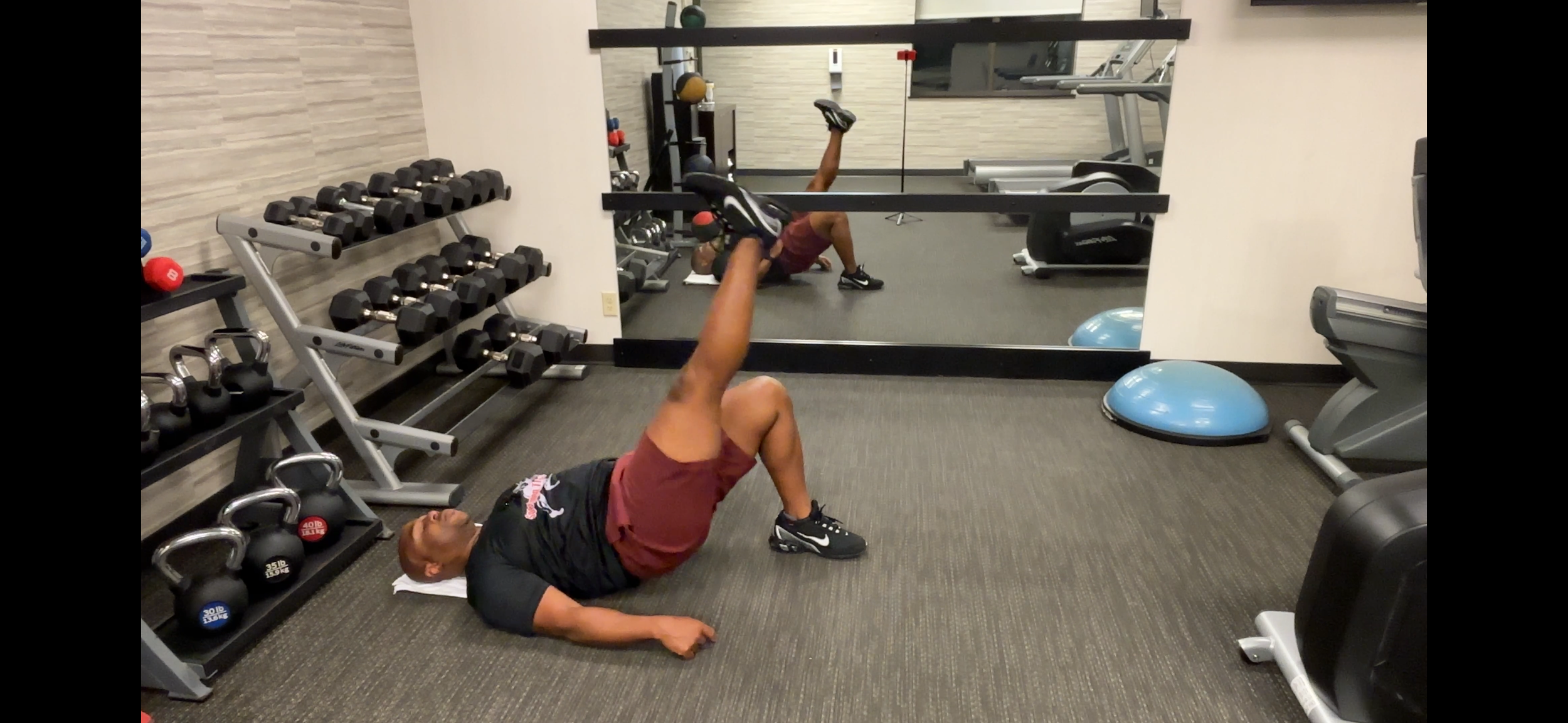
Single-leg glute bridge, right leg
Single-leg glute bridge, left leg
No change of clothes. No equipment. Fits between your 9 AM and 10 AM.
Sample December 15 Schedule
9:50 AM: 5-minute office circuit between calls.
11:30 AM: 1 to 2 minutes of fast stair climbing before the holiday lunch.
1:30 PM: 10-minute brisk walk after lunch.
3:00 PM: Two sets of band rows or desk push-ups to break up the afternoon.
Evening: 10-minute walk after dinner. Look at the neighborhood lights.
That is roughly 30 minutes of training. No single block took more than 10.
Why Exercise Snacking Works for Busy Professionals
√ It fits your real schedule. A 60-minute session is easy to cancel. A 5-minute one is hard to justify skipping.
√ It manages stress. Short bouts of movement break up long stretches of sitting and give your mind a reset between high-stakes tasks.
√ It protects blood sugar. Holiday meals are bigger and more frequent. Movement before and after meals helps your body handle them.
√ It keeps the habit alive. The biggest cost of the holidays is the restart in January. Snacking keeps you in motion, so there is nothing to restart.
It checks a lot of boxes that would result in a fit holiday season!
Your Holiday Exercise Snacking Strategy
Map your windows. Look at tomorrow's calendar. Find three gaps of 5 to 10 minutes. Between meetings, before meals, and while dinner cooks are reliable choices.
Anchor snacks to meals. A short effort before eating and a walk after eating are the easiest habits to stack, and they carry the blood sugar benefit.
Make it hard enough. A snack should raise your heart rate or challenge your muscles. Choose full-body moves like squats, lunges, push-ups, and stair climbs. Keep a resistance band in your desk or bag.
Schedule it like a meeting. Put the snacks on your calendar. If it is not scheduled, it will not happen in December.
Aim for maintenance. The goal this season is to protect what you have built. Track how many snacks you complete each day. Consistency is the win.
If you are new to vigorous exercise or have a heart condition, talk with your physician before adding hard intervals like stair sprints.
Common Questions About Exercise Snacking
How long should each exercise snack be?
Anywhere from 20 seconds to 10 minutes. Shorter snacks should be harder. Longer snacks, like a brisk walk, can be moderate.
Can exercise snacking really maintain my fitness?
Yes, for most people. Research shows short bouts spread across the day can match a single longer session for fitness and cardiovascular risk. If you already train hard, snacking will help you hold your gains through a busy stretch.
What are the best exercise snacks for an office?
Bodyweight squats, reverse lunges, desk push-ups, glute bridges, band rows, and stair climbs. All take little space and no change of clothes.
When is the best time to snack?
Before and after meals are strong options. Breaking up long periods of sitting also helps. The best time is the one you will actually keep.
Make This Your Fittest Holiday Season Yet
You do not need perfect circumstances to stay fit this December. You need a plan that fits the days you actually have.
If your energy, sleep, and stress have already started to slip, start with the Executive Recovery Audit. It shows you where your recovery stands and what to fix first, so the plan you follow this season is built around your schedule.
You will like how your fitness survives the holiday season, and your January self will thank you.
[Call to Action Button: Take the Executive Recovery Audit]
Button link: specimentraining.com/executive-recovery-audit
References
Murphy M, Nevill A, Neville C, Biddle S, Hardman A. Accumulating brisk walking for fitness, cardiovascular risk, and psychological health. Med Sci Sports Exerc. 2002;34(9):1468-74. PubMed
Accumulated versus continuous postprandial walking and cardiometabolic health markers in insufficiently active adults (2020). PubMed
Little JP, Langley J, Lee M, et al. Sprint exercise snacks: a novel approach to increase aerobic fitness. Eur J Appl Physiol. 2019;119(5):1203-1212. PubMed
Francois ME, Baldi JC, Manning PJ, et al. "Exercise snacks" before meals: a novel strategy to improve glycaemic control in individuals with insulin resistance. Diabetologia. 2014;57(7):1437-45. PubMed
Stamatakis E, Ahmadi MN, Gill JMR, et al. Association of wearable device-measured vigorous intermittent lifestyle physical activity with mortality. Nat Med. 2022;28(12):2521-2529. PMC full text