The Hidden Metric Behind Every High Performer: Restorative Time
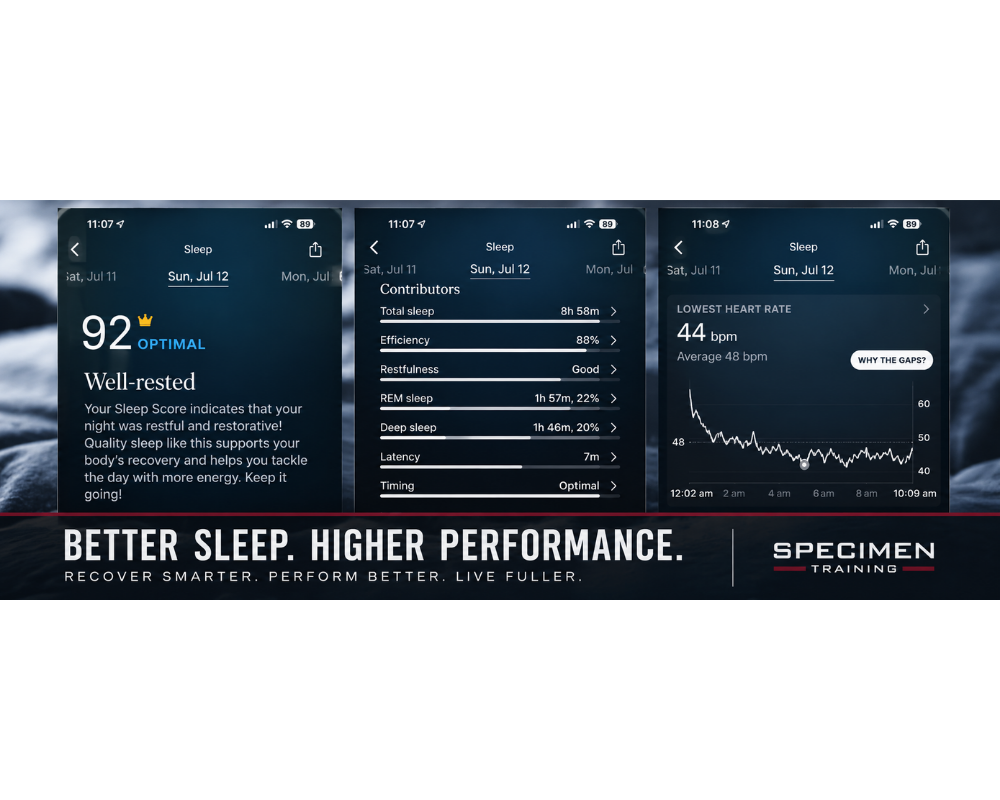
This was my data from July 12, but most trackers keep the same or similar metrics - start paying attention to them!
You track your revenue. You track your calendar. You track your workouts.
But are you tracking how well your body actually recovers from all of it?
For most high achievers, recovery is an afterthought, something that happens (or doesn't) between everything else on the schedule. But here's what the data shows: the people who perform at the highest levels over the longest periods of time are not just training harder or working smarter. They are recovering better.
There is a term for this: restorative time.
Restorative time is not just the hours you spend asleep. It is the quality of physiological repair happening inside your body during those hours. And there are three key metrics that tell you exactly how much of it you are actually getting.
What Is Restorative Time, and Why Does It Matter?
Think of your body like a high-performance engine. You push it hard during the day (mentally, physically, emotionally). Cortisol spikes, inflammation builds, your nervous system runs hot. That is by design.
But the rebuild happens at night.
Restorative time is the window when your body shifts into repair mode: tissue rebuilds, the brain clears metabolic waste, hormones reset, and your nervous system recalibrates for the next day. Without enough of it, you accumulate what researchers call an "allostatic load" - basically, biological debt that compounds over time.
For high achievers, this matters more than most. The stress load of running a business, leading a team, or managing high-stakes decisions every day is enormous. Your recovery requirement is not average. It is higher than average…which means the cost of ignoring it is also higher.
The good news is that three measurable metrics can tell you exactly where you stand.
Heart Rate Variability (HRV): Your Nervous System's Report Card
HRV measures the variation in time between each heartbeat. That might sound like something only doctors care about, but it is one of the most powerful windows into how recovered you actually are.
Here is the simple version: your heart rate is not perfectly steady, even at rest. A healthy nervous system produces slight variations between beats — maybe 850 milliseconds, then 920, then 870. That variation is a sign that your autonomic nervous system is flexible and responsive. It means your body is actively shifting between stress and recovery modes, rather than stuck in one gear.
Low HRV means your body is still running in fight-or-flight mode, even while you sleep. High HRV means you are genuinely in a parasympathetic state, which is the biological green light for restoration.
Research published in the International Journal of Environmental Research and Public Health confirms that HRV is a reliable marker of recovery status and autonomic function, with consistently low readings correlating to burnout, overtraining, and performance decline.
In short: if your HRV is trending down, your restorative time is not doing its job, regardless of how many hours you spent in bed.
We will go deep on HRV in its own dedicated post. There is a lot more to unpack, including how to use your trends over time rather than day-to-day readings.
Resting Heart Rate (RHR): The Simplest Signal You Might Be Ignoring
Resting heart rate is exactly what it sounds like: how many times your heart beats per minute while you are completely still. Most wearables measure it overnight, which gives you the cleanest reading.
A lower RHR generally indicates better cardiovascular efficiency and deeper recovery. When your body has genuinely restored during sleep, your heart does not have to work as hard. It has had time to clear inflammation, balance electrolytes, and reduce the hormonal demands from the previous day.
When RHR spikes, something is off. That spike, even without any other symptoms, is often one of the earliest signs of accumulated fatigue, oncoming illness, or nervous system overload. Studies have shown that an increase of even five to seven beats per minute above your baseline can precede physical breakdown by 24 to 48 hours.
For the high achiever, this is an early warning system. A rising RHR in the context of high workload is your body flagging that restorative time is insufficient before you consciously feel it.
The goal is not to chase the lowest possible number. The goal is to understand your baseline and pay attention when it shifts.
RHR deserves its own conversation, particularly around how training load, caffeine, alcohol, and stress each affect it differently. That post is coming.
Sleep Stages: Where the Actual Restoration Happens
You can spend eight hours in bed and still wake up exhausted. Sleep quantity and sleep quality are not the same thing, and the difference lives in your sleep stages.
Your body cycles through several stages throughout the night, but two matter most for restorative time:
Deep sleep (slow-wave sleep) is where your body does its physical repair work. Growth hormone is released during this stage, driving muscle repair, immune function, and cellular recovery. Your brain also clears adenosine (the waste product that builds up during wakefulness and creates that heavy, foggy feeling when it accumulates). Adults should spend roughly 15 to 20% of total sleep time in deep sleep.
REM sleep is where your nervous system and brain recover. Emotional regulation, memory consolidation, and cognitive restoration all peak during REM. For high achievers managing complex decisions and high social demands all day, REM is not optional. Low REM sleep is directly linked to impaired executive function, emotional reactivity, and reduced stress tolerance the following day.
You can learn a little more about REM sleep here!
The research is clear: even one or two nights of disrupted deep and REM sleep measurably impairs cognitive performance, reaction time, and emotional control — at levels comparable to being legally impaired.
Sleep stages are a topic we will spend much more time on, including what actually drives quality deep sleep and why your REM is often the first casualty of alcohol and late nights.
The Connection: Why All Three Point to the Same Thing
HRV, RHR, and sleep stages are not separate conversations. They are three lenses on the same biological reality.
When restorative time is working, all three trend in the right direction: HRV climbs, RHR stays low and stable, and your wearable shows healthy deep and REM percentages. When restoration breaks down - whether from stress, poor sleep habits, overtraining, or schedule chaos, all three signal it.
That is the power of tracking them together. No single metric tells the full story. But when two or three of them shift at the same time, you know something real is happening.
For the high achiever, the practical takeaway is this: restorative time is the foundation that everything else is built on. Energy, focus, productivity, emotional regulation, physical performance — all of it degrades when recovery quality is low. And all of it improves when you start treating recovery as part of the work, not a break from it.
Where to Start
You do not need to overhaul everything at once. Start by tracking.
If you wear a device like a WHOOP, Garmin, or Oura Ring, you already have access to HRV, RHR, and sleep stage data. Spend two weeks simply observing your baselines without trying to change anything. Note how the numbers shift on high-stress days, after poor sleep, after alcohol, after a hard workout.
Awareness is the first step. Once you know your baseline, you can start identifying what is getting in the way of your restorative time…and that is where real optimization begins.
We will be diving much deeper into each of these three metrics in the weeks ahead. In the meantime, if you want a more personalized look at your recovery data and what it means for your performance, reach out.
The work you do matters. So does the recovery behind it.
When you’re ready to level up, Start Your Transformation