No carbs after 6 p.m. No sugar. No eating before noon. Only eat "clean."
You've probably tried a few of these rules. Maybe one even worked for a while.
Here's what most of them had in common. When they worked, it was because they changed how much you ate. Not because of the rule itself.
When researchers at the National Institutes of Health tightly control what people eat, diets with very different carb and fat ratios produce nearly identical fat loss once calories are matched. The rule was never the magic. The calories were.
That's why calories sit at the base of the Specimen Training Performance Fueling System. Level 1. The foundation everything else is built on.
Here's the simple picture of why, and how to make it work without living hungry.
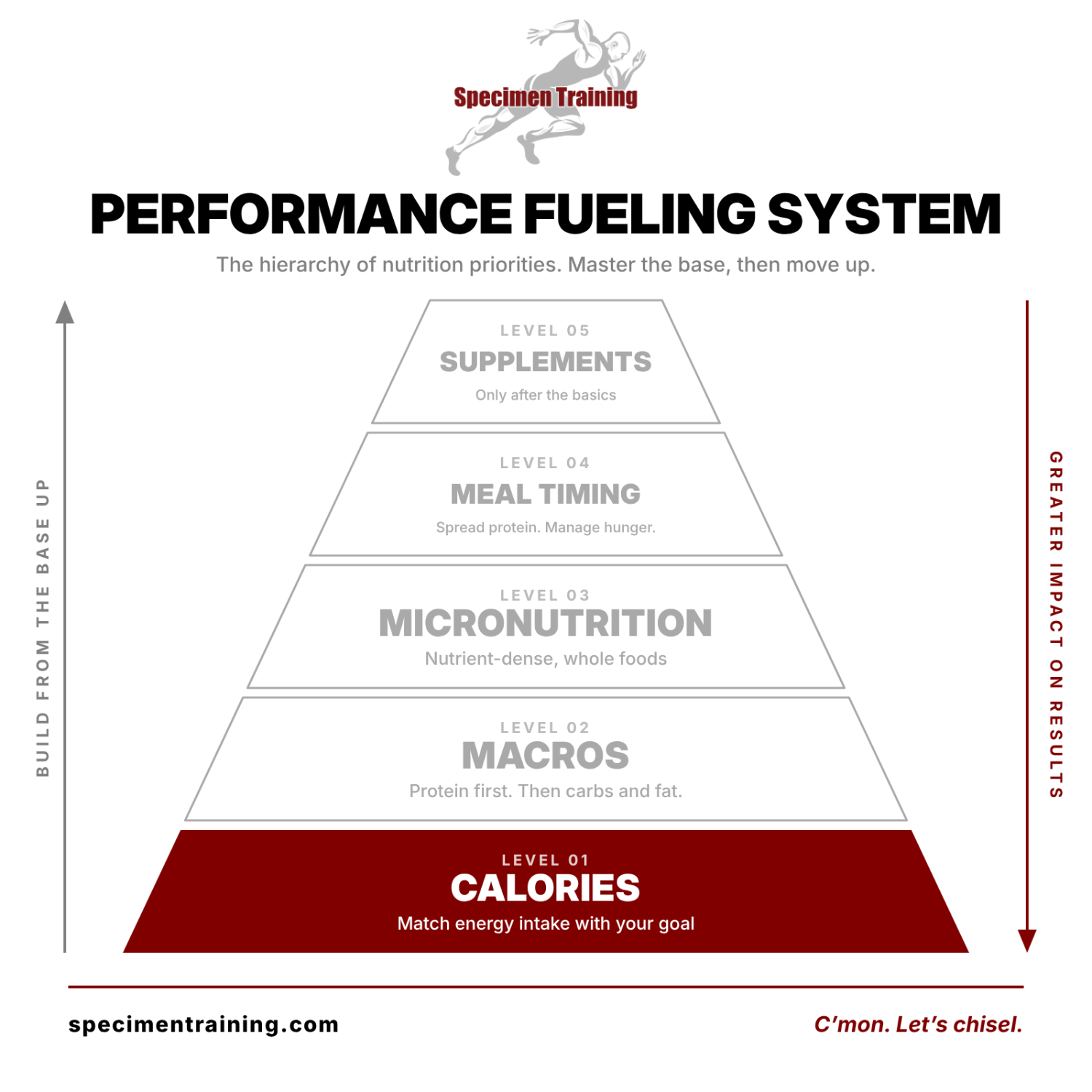
New to the series? Start with the hub post: The Performance Fueling System: Your Hierarchy of Nutrition Priorities.
Think of Calories as Your Energy Budget
A calorie is a unit of energy. That's it. Not good. Not bad. Just energy.
Your body runs on an energy budget, the same way your business runs on a cash budget.
Food and drink are deposits.
Everything your body does is a withdrawal.
Over time, the math decides what happens:
Deposit more than you spend, and the extra gets stored. Some can become muscle if you train for it. Much of it becomes fat.
Spend more than you deposit, and your body draws from savings. Ideally, stored fat.
Match the two, and your weight holds steady.
That's energy balance. Every diet that has ever worked runs on it, whether it admits it or not.
Where Your Calories Actually Go
Most people think exercise is their biggest withdrawal. It usually isn't. Your daily burn has four parts.
Keeping you alive. Breathing, heartbeat, brain function, body temperature. This is your resting metabolism, and it's the largest share for most people, roughly 60 to 70% of the daily total. If you’re wondering, muscle mass is the biggest influencer on your resting metabolism. It’s one of a few important reasons we do everything we can to protect and increase it.
Digesting food. Breaking down and absorbing what you eat costs about 10% of your intake. This is known as the Thermic Effect of Food. Protein costs the most to digest.
Exercise. Your workouts. Essential for health and body composition, but often a smaller slice than people assume. A 45-minute session might burn a few hundred calories. One restaurant dessert can cover it.
Everything else you move. Walking to meetings, taking the stairs, pacing on calls, even fidgeting. Scientists call it NEAT: non-exercise activity thermogenesis.
That last one is the wild card. In a well-known study published in Science, researchers overfed volunteers by 1,000 calories a day for eight weeks. Fat gain varied roughly tenfold from person to person. The biggest reason: some people unconsciously moved more, burning up to about 700 extra calories a day through everyday movement. Others barely changed.
For a professional who sits 10 hours a day, this matters. Your desk job shrinks your withdrawals. Daily steps and short walks after meals add them back.
Why Calories Are the Foundation
Here's the simplest way to see it. Every other level of the pyramid works inside your calorie budget.
Macros (Level 2) decide how you split the budget between protein, carbs, and fat.
Micronutrition (Level 3) decides the quality of what you buy with it.
Meal timing (Level 4) decides when you spend it.
Supplements (Level 5) are a rounding error on the bill.
Change your macros, and the budget is still the budget. Eat perfectly clean food, and the budget is still the budget. Time your meals to the minute, and the budget is still the budget.
You can't out-macro, out-clean, or out-time a calorie intake that doesn't match your goal. Get Level 1 wrong, and the rest of the pyramid sits on sand. Get it right, and every level above it starts paying off.
Quantity Sets the Direction. Quality Makes It Doable.
This is the part most people get wrong. Calories at the base does not mean "just eat less."
Calories decide which direction your body moves. Food choices decide how hard the trip feels.
In a tightly controlled NIH study, people ate an ultra-processed diet and a minimally processed diet for two weeks each. The meals offered matched calories, sugar, fat, and fiber. On the ultra-processed diet, people ate about 500 more calories a day without trying, and gained weight. On the whole-food diet, they ate less and lost weight.
Same people. Different food. Very different results.
So the goal isn't to eat as little as possible. It's to hit your number with food that keeps you full, fueled, and sharp through a 12-hour day. Most of my clients are surprised by how much food that is.
Your Number Isn't Fixed. It Matches Your Goal.
Level 1 is not one number forever. In the Performance Fueling System, your calorie target matches your training phase. Each phase runs 4 to 5 weeks.
Conditioning: a slight deficit. Spend a little more than you take in. This is where fat loss happens.
Hypertrophy: maintenance. Deposits match withdrawals. You fuel muscle growth without chasing the scale.
Strength: maintenance or a slight surplus. More fuel for heavier training.
Notice the word "slight." It matters.
When researchers compared two rates of weight loss in elite athletes, the slower group (about 0.7% of body weight per week) gained lean mass while losing fat. The faster group (about 1.4% per week) did not.
Crash diets cost you muscle, energy, and focus. They also trigger metabolic adaptation, where your body cuts the energy it spends to defend its weight. The harder you cut, the harder it pushes back.
A slight deficit looks slower on paper. It's faster in real life, because you can actually sustain it.
Why Your Best Guess Is Probably Wrong
Here's the uncomfortable part. Most of us are bad at estimating both sides of the budget.
In a classic study in the New England Journal of Medicine, people who believed they were "diet resistant" underreported what they ate by 47%. They overreported their activity by 51%. They weren't lying. They were human.
Fitness watches and online calculators help, but they estimate too. Treat any formula as a starting point, not a verdict.
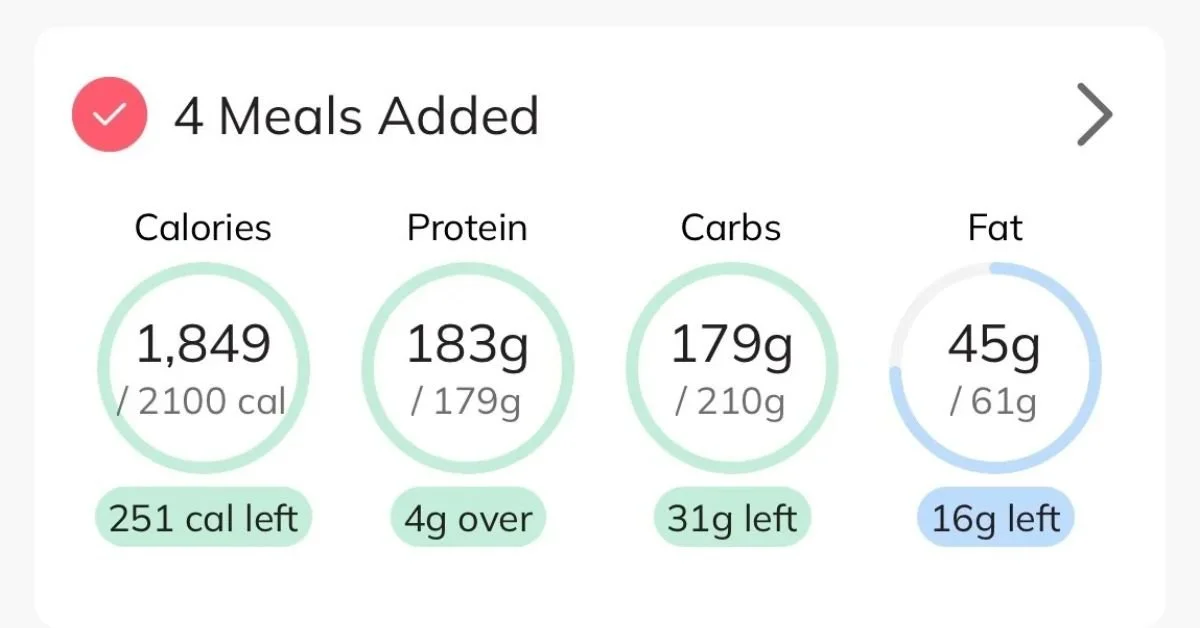
The most reliable number comes from you: what you actually eat, tracked honestly, compared with what your weight does over two to three weeks. We use MyFitnessPal…it integrates with the app.
How to Put Level 1 Into Practice
Track for 7 days without changing anything. Awareness first. You can't adjust what you can't see. This is the first nutrition assignment every Fit4Success client gets.
Find your maintenance. Compare your average daily intake with your weekly average weight over two to three weeks. If your weight holds steady, you've found roughly your maintenance number. (the app does all the averaging for you).
Set your target by phase. A slight deficit for fat loss. Maintenance to build. Maintenance or a slight surplus for strength.
Adjust in small steps. If progress stalls for two weeks, change your intake by 100 to 200 calories, not 500.
Judge by weekly averages. Daily swings of 2 to 5 pounds are normal. Water, salt, stress, and travel all move the scale.
Fill your budget with high-volume foods. Lean protein, vegetables, fruit, and whole grains let you eat big, satisfying meals and still hit your number.
What Comes Next: Level 2, Macros
Calories set your budget. Macros decide how you spend it. In the next post, we'll break down why protein is the priority macro, especially for busy professionals over 40, and how to split the rest between carbs and fat.
Build Your Foundation With a Fit4Success Program
Fit4Success 12- or 16-week programs include training, recovery, nutrition, and accountability built for professionals. The Performance Fueling System is the nutrition engine that fuels them.
Your calorie target is set from your real data, matched to your training phase, and adjusted as your body responds. No crash diets. No guessing. Just a foundation built on science that holds.
C’mon. Let’s chisel.
References
Hall KD, Guo J. Obesity energetics: body weight regulation and the effects of diet composition. Gastroenterology. 2017;152(7):1718-1727. https://pubmed.ncbi.nlm.nih.gov/28193517/
Westerterp KR. Diet induced thermogenesis. Nutr Metab (Lond). 2004;1(1):5. https://pubmed.ncbi.nlm.nih.gov/15507147/
Levine JA, Eberhardt NL, Jensen MD. Role of nonexercise activity thermogenesis in resistance to fat gain in humans. Science. 1999;283(5399):212-214. https://pubmed.ncbi.nlm.nih.gov/9880251/
Hall KD, Ayuketah A, Brychta R, et al. Ultra-processed diets cause excess calorie intake and weight gain: an inpatient randomized controlled trial of ad libitum food intake. Cell Metab. 2019;30(1):67-77. https://pubmed.ncbi.nlm.nih.gov/31105044/
Garthe I, Raastad T, Refsnes PE, Koivisto A, Sundgot-Borgen J. Effect of two different weight-loss rates on body composition and strength and power-related performance in elite athletes. Int J Sport Nutr Exerc Metab. 2011;21(2):97-104. https://doi.org/10.1123/ijsnem.21.2.97