Picture two executives. Same height. Same weight. Both eat 2,200 calories a day for 16 weeks.
One eats 60 grams of protein a day. The other eats 180.
Same calorie budget. By week 16, they will not look, feel, or perform the same.
In Level 1, we set the budget. Calories decide which direction your body moves. Level 2 decides how you spend that budget, and that decides what your body builds, keeps, and burns along the way.
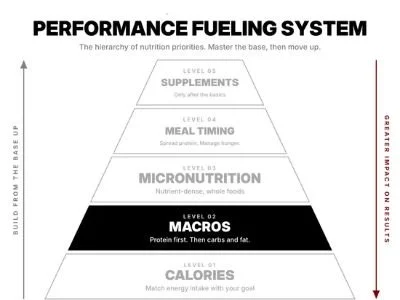
Welcome to macros. Level 2 of the Specimen Training Performance Fueling System.
New to the series? Start with the hub post, The Performance Fueling System: Your Hierarchy of Nutrition Priorities, then read Level 1: Calories.
Macros Are Just Calories, Sorted
Every calorie you eat comes from one of three macronutrients:
Protein: 4 calories per gram
Carbohydrates: 4 calories per gram
Fat: 9 calories per gram
Alcohol is the unofficial fourth at 7 calories per gram. It's the one nobody tracks, and it adds up fast.
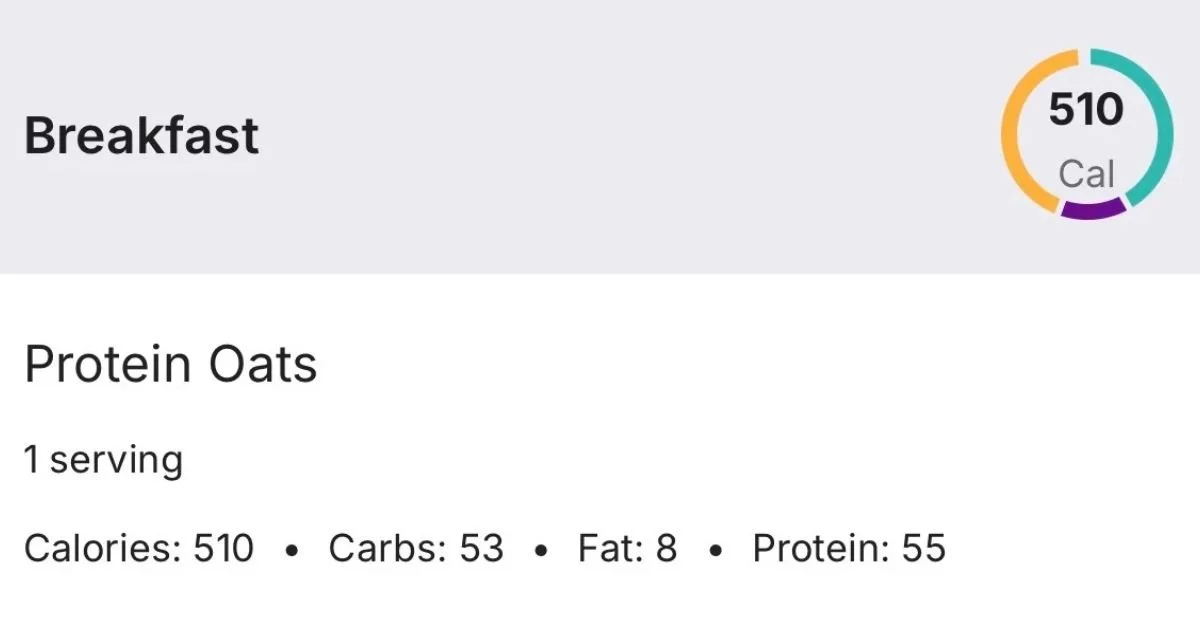
Here's what that looks like in real life. This is my breakfast from the app (it’s one of my go-to breakfasts): Protein Oats. 510 calories. 53 grams of carbs, 8 grams of fat, and 55 grams of protein.
Do the math:

55 grams of protein x 4 = 220 calories
53 grams of carbs x 4 = 212 calories
8 grams of fat x 9 = 72 calories
That's 504 calories. Food labels round, so the app shows 510. Close enough.
That's the whole idea. Macros don't replace calories. They break your calories into parts. Level 1 sets the total. Level 2 decides the mix.
And notice the mix on that plate. Protein makes up more than 40% of the meal. That's on purpose.
Protein Is the Priority Macro
If you only track one macro, track protein. It does four jobs that matter for fat loss and performance.
It protects muscle when you're in a deficit. In a study in the American Journal of Clinical Nutrition, men in a steep calorie deficit ate either 1.2 or 2.4 grams of protein per kilogram of body weight while training hard. The higher-protein group gained lean mass and lost more fat. The lower-protein group didn't gain lean mass.
It controls hunger. When researchers raised protein to 30% of calories, people ate about 441 fewer calories a day on their own. No counting required.
It builds strength. A large meta-analysis in the British Journal of Sports Medicine found that protein boosted gains in muscle and strength from training, with benefits leveling off around 1.6 grams per kilogram per day.
It costs more to digest. Your body burns roughly 20 to 30% of protein's calories just processing it. For carbs, it's about 5 to 10%. For fat, it's close to zero. That 20 to 30% increase is adding to the total calories your body spends each day!
Fewer cravings. More muscle kept. A little extra burn. That's why protein comes first in every plan we build.
Why Protein Matters More After 40
Most of my clients are between 30 and 60. Here's what changes with age.
Muscle gets less responsive to protein. Researchers call it anabolic resistance. In one study, older men needed a meaningfully larger protein dose per meal, relative to body weight, to get the same muscle-building signal as younger men.
That has two practical consequences:
The per-meal dose matters. A 15-gram snack of protein might do the job at 25. At 55, it often won't.
Skipping protein costs more. Muscle is your metabolism, your strength, and your long-term health. You lose it faster and rebuild it slower as you age.
The good news: muscle still responds at any age. It just needs a bigger, more consistent signal.
How Much Protein Do You Need?
A practical target for most active adults is 0.7 to 1 gram per pound of goal body weight per day. That's roughly 1.6 to 2.2 grams per kilogram.
If your goal weight is 180 pounds, that's about 126 to 180 grams a day.
Then spread it out. Research on muscle building shows moderate doses spread through the day work better than one big protein dinner. A good rhythm for most professionals:
30 to 50 grams per meal
3 to 4 meals a day
My overnight protein oats land at 55 grams. One meal down, and a big part of the day's target is already covered before the first meeting.
Carbs Are Not the Enemy
Carbs have been blamed for almost everything. The research doesn't back it up.
In the DIETFITS trial at Stanford, more than 600 adults followed either a healthy low-fat or a healthy low-carb diet for a full year. Weight loss was about the same in both groups. What mattered was eating fewer calories from quality food, not cutting one macro to the bone.
Carbs earn their place:
They fuel your training. Carbs are your muscles' preferred fuel for hard, intense work.
They fuel your brain. Long workdays and late meetings run better with steady energy.
They bring fiber. Whole grains, fruit, vegetables, and beans keep you full and support your gut. More on that in Level 3.
The key is the type and the timing. Choose mostly whole-food carbs. Place more of them around your workouts. Let them flex with your training.
Fat: Essential, but Easy to Overdo
Fat is not the enemy either. Your body needs it to make hormones, absorb vitamins A, D, E, and K, and stay full between meals. U.S. Dietary Guidelines suggest fat make up 20 to 35% of daily calories for most adults.
But fat has 9 calories per gram, more than double protein and carbs. That makes it easy to overshoot without noticing.
One tablespoon of olive oil = about 120 calories
A small handful of nuts = about 170 calories
Creamy salad dressing at a client lunch: often = 150 to 200 calories
None of these are bad foods. They're just dense. A heavy pour of oil can quietly erase a calorie deficit you worked hard for.
Your Macros Change With Your Phase
In the Performance Fueling System, your calories match your training phase. Your macros do too. One rule holds the whole thing together:
Protein stays steady. Carbs and fat flex.
Conditioning (slight deficit): Protein stays high to protect muscle. The deficit comes mostly from carbs and fat.
Hypertrophy (maintenance): Carbs rise to fuel more training volume. Protein holds.
Strength (maintenance or slight surplus): Carbs are usually at their highest to fuel heavier sessions. Protein still holds.
This is why we don't hand out a fixed macro split. The right numbers depend on your goal, your phase, and your schedule.
How to Put Level 2 Into Practice
Set protein first. Use 0.7 to 1 gram per pound of goal body weight. Everything else fills in around it.
Anchor every meal with protein. Decide the protein, then build the plate. Aim for 30 to 50 grams per meal.
Have two or three go-to high-protein meals. My protein oats are one. Repeatable meals make hitting your number automatic.
Let carbs and fat fill the rest. Base the split on your training, your phase, and what you enjoy enough to stick with.
Watch the fat creep. Measure oils, dressings, and nut butters for a few weeks. Your eyes will learn fast.
Count the drinks. Alcohol has calories and no protein. Log it like any other food.
Close beats perfect. Hit your protein most days and stay near your calorie target. You don't need to match every gram.
What Comes Next: Level 3, Micronutrition
Calories set the budget. Macros decide how you spend it. Level 3 is about quality: the vitamins, minerals, and fiber that keep you healthy, sharp, and full. It's also where we'll show why whole food makes Levels 1 and 2 so much easier to hit.
Dial In Your Macros With a Fit4Success program
All Fit4Success programs include TRAINING, NUTRITION, and LIFESTYLE INTEGRATION (with accountability) systems, built specifically for high performing professionals. The Performance Fueling System is its nutrition engine.
Your protein target is set for your body and goal. Your carbs and fat flex with your training phase. And every number is adjusted as your body responds. No cookie-cutter splits. No guessing. It’s a science-backed system customized just for you.
C’mon. Let’s chisel.
References
Longland TM, Oikawa SY, Mitchell CJ, Devries MC, Phillips SM. Higher compared with lower dietary protein during an energy deficit combined with intense exercise promotes greater lean mass gain and fat mass loss: a randomized trial. Am J Clin Nutr. 2016;103(3):738-746. https://pubmed.ncbi.nlm.nih.gov/26817506/
Weigle DS, Breen PA, Matthys CC, et al. A high-protein diet induces sustained reductions in appetite, ad libitum caloric intake, and body weight despite compensatory changes in diurnal plasma leptin and ghrelin concentrations. Am J Clin Nutr. 2005;82(1):41-48. https://pubmed.ncbi.nlm.nih.gov/16002798/
Morton RW, Murphy KT, McKellar SR, et al. A systematic review, meta-analysis and meta-regression of the effect of protein supplementation on resistance training-induced gains in muscle mass and strength in healthy adults. Br J Sports Med. 2018;52(6):376-384. https://pubmed.ncbi.nlm.nih.gov/28698222/