The Performance Fueling System: Your Hierarchy of Nutrition Priorities
A new fat burner. A 16-hour fasting window. A celery juice cleanse. A $90 tub of something with a lab-coat label.
Most people start their nutrition plan at the very top of the pyramid. They chase the small details because the small details feel new. Meanwhile the fundamentals that drive the vast majority of results sit untouched.
I have coached Olympic-level athletes and I coach busy attorneys and executives. The best results in both groups come from the same place. Not from secrets. From mastering the basics in the right order.
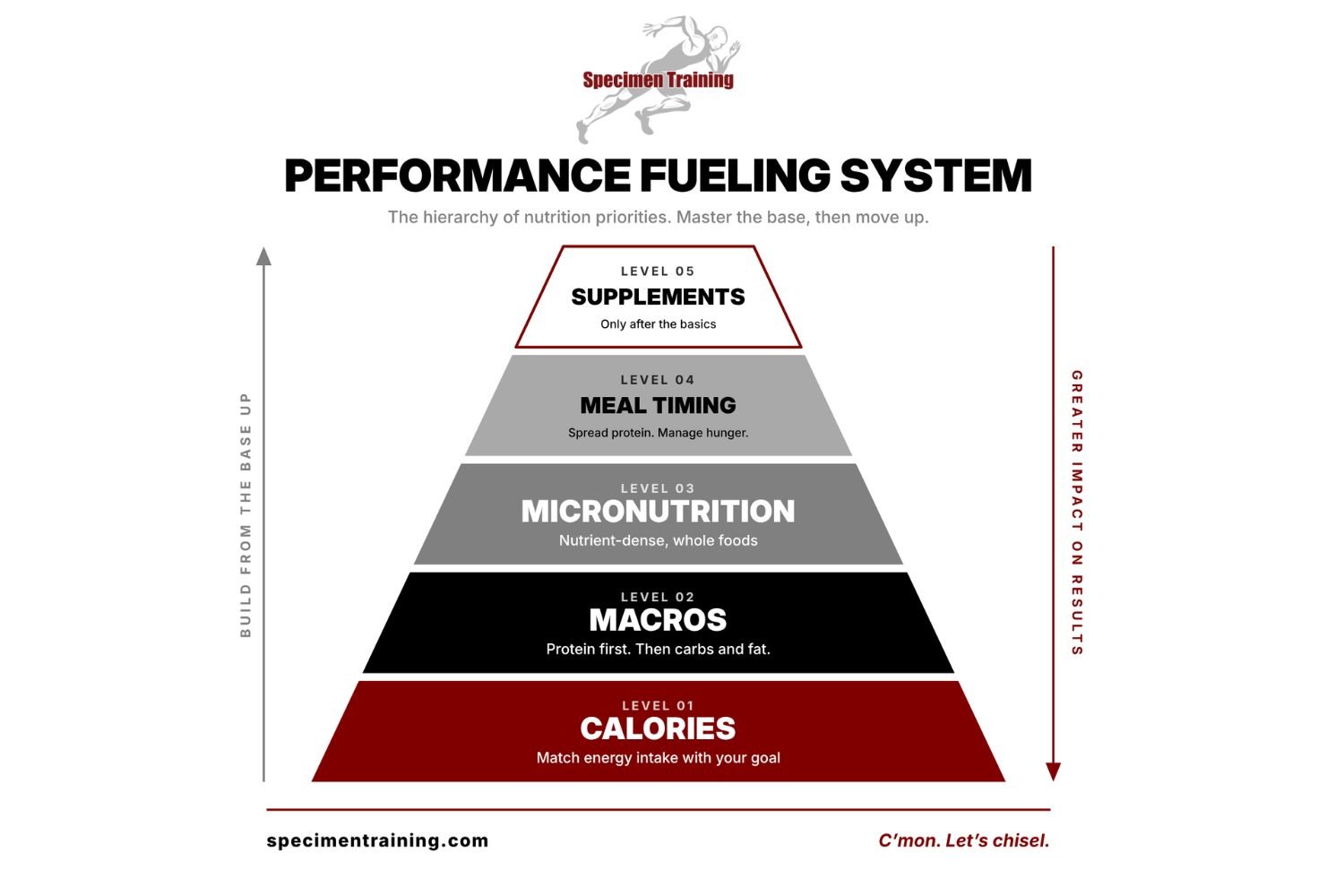
That order has a name. It is the Specimen Training Performance Fueling System, the nutrition framework behind every Fit4Success client plan.
And performance means more than the gym. For an attorney in trial, an executive closing the quarter, or an engineer shipping a launch, performance is a 12-hour day with a clear head. It is the late meeting that gets your best thinking, not your leftovers. Food fuels all of it.
Understanding and mastering the fundamentals is where your sustainable results are. Here are the five levels of the system, ranked from most important to least.
Level 1: Calories
Please do not confuse this with "just eat less."
Level 1 is about matching your energy intake to your goal. For fat loss, that means a calorie deficit.
That part is not up for debate. When researchers at the National Institutes of Health tightly control food intake, diets with very different carb and fat ratios produce nearly identical fat loss once calories are matched. Energy balance runs the show.
But here is what most people get wrong. They assume a deficit means hunger, small plates, and misery. It does not have to.
Why most people misjudge their intake
In a classic study in the New England Journal of Medicine, people who believed they were "diet resistant" underreported what they ate by 47% and overreported their activity by 51%. These were not liars. They were normal humans. We are all bad at estimating.
The flip side is also true. Many of my clients are under-eating at breakfast and lunch, then losing the battle at 9 p.m. They are not eating too much food. They are eating the wrong food at the wrong times.
Why you can eat more than you think
Food volume matters. Research on energy density shows that people tend to eat a similar weight of food each day. Fill that weight with lean protein, vegetables, fruit, and whole grains and you can eat large, satisfying meals while staying in a deficit. Fill it with ultra-processed snacks and the calories pile up fast.
That is why calories sit at the top, but they do not stand alone. You can eat far more than you think, as long as you follow Level 2.
Put it into practice
Track your intake for 7 days without changing anything. Awareness first.
Aim for a moderate deficit. Losing roughly 0.5% to 1% of body weight per week preserves muscle and energy far better than a crash diet.
Build meals around high-volume, low-calorie foods so the plate looks full.
Level 2: Macros
This is the foundation of how we build every client's nutrition plan inside the Performance Fueling System.
Calories tell you how much to eat. Macros (protein, carbohydrates, and fat) tell you what that food is made of. Two people can eat the same calories and get very different results based on how those calories are split.
Protein is the priority macro
Protein does three jobs that matter for fat loss.
It protects muscle. In a study in the American Journal of Clinical Nutrition, men in a steep calorie deficit ate either 1.2 or 2.4 grams of protein per kilogram of body weight while training hard. The higher-protein group gained lean mass and lost more fat. The lower-protein group simply maintained.
It controls hunger. When researchers raised protein to 30% of calories, participants spontaneously ate about 441 fewer calories per day. No counting required.
It builds strength. A large meta-analysis in the British Journal of Sports Medicine found that protein boosted gains in muscle and strength from training, with benefits leveling off around 1.6 grams per kilogram per day.
For my clients aged 30 to 60, protein matters even more. As we age, muscle becomes less responsive to protein. Older adults need a larger dose per meal to get the same muscle-building signal as younger people.
Carbs and fat fill in the rest
Once protein is set, carbs and fat fill the remaining calories. Carbs fuel your training and your brain during long workdays. Fat supports hormones and helps you absorb key vitamins. Neither is the enemy. The right split depends on your training, your schedule, and what you can sustain.
Put it into practice
Start with protein. A practical target for most active adults is 0.7 to 1 gram per pound of goal body weight.
Spread it out. Aim for 30 to 50 grams of protein at each of 3 to 4 meals.
Let carbs and fat flex around your training days and personal preferences.
Level 3: Micronutrition
Yes, nutrient-dense food matters.
Micronutrients are the vitamins, minerals, and fiber that keep the machine running. They will not show up on the scale this week. They show up in your energy, your recovery, your blood work, and your long-term health.
Most adults fall short. According to CDC data, only about 1 in 10 American adults eats the recommended amount of vegetables, and only about 1 in 8 eats enough fruit.
Food quality also affects how much you eat
In a tightly controlled NIH study, people ate an ultra-processed diet and a minimally processed diet for two weeks each. The meals were matched for calories, sugar, fat, and fiber on offer. On the ultra-processed diet, people ate about 500 more calories per day and gained weight. On the whole-food diet, they lost weight.
This is why Level 3 supports Level 1. Whole foods make the calorie deficit easier to hit.
Fiber deserves special attention
A major review in The Lancet found that people eating 25 to 29 grams of fiber per day had a 15% to 30% lower risk of death from all causes and from heart disease than people eating the least. Fiber also slows digestion and keeps you full longer.
Put it into practice
Prioritize vegetables, fruit, whole grains, dairy, nuts, legumes, and lean meats.
Get a vegetable or fruit at every meal. Frozen counts.
Work toward 25 to 35 grams of fiber per day. Increase slowly and drink water.
Follow the 80/20 rule. Most of your food from whole sources, with room for the foods you enjoy.
Level 4: Meal Timing and Frequency
A lot can be done to curb hunger by timing your meals well.
Notice where this sits on the list. Meal timing is real, but it is a fine-tuning tool. It cannot rescue a plan that ignores calories and protein.
What the research says
A meta-analysis in Nutrition Reviews found that eating more or fewer meals per day made little difference to body composition once total calories and protein were equal. A randomized trial of time-restricted eating in JAMA Internal Medicine found that a 16:8 fasting window produced no meaningful extra weight loss compared to a normal eating schedule.
In other words: there is no magic window. The best schedule is the one that helps you hit Levels 1 through 3 with the least friction.
Where timing does help
Protein distribution. Muscle responds better to moderate doses spread across the day than to one big protein dinner. One study found that 20 grams every 3 hours stimulated more muscle building than the same total eaten in larger, less frequent doses.
Hunger management. Skipping meals early often leads to overeating late. A protein-rich breakfast or lunch can prevent the 9 p.m. pantry raid.
Training fuel. Eating a meal with carbs and protein in the hours around your workout supports performance and recovery.
Put it into practice
Pick a meal rhythm that fits your calendar. Three meals and a snack works well for most professionals.
Front-load protein. Do not save most of it for dinner.
If you are always starving at night, move more food earlier in the day.
Take a 10-minute walk after meals to help manage blood sugar.
Level 5: Supplements
Supplements are NOT a shortcut to your goals, whether they come as a ready-to-drink shake, a pill, or a powder.
They are meant to supplement (hence the word) a solid nutrition program. If Levels 1 through 4 are not in place, no product will fix that.
I have no supplement company affiliations. Nobody pays me to recommend anything. So here is the honest view.
A short list has real evidence
Protein powder: Not magic. Just convenient food. Helpful when you cannot hit your protein target with meals alone.
Creatine monohydrate: One of the most researched supplements in sports nutrition. It supports strength, power, and lean mass, and has a strong safety record at 3 to 5 grams per day.
Caffeine: A proven performance aid. Keep it well away from bedtime so it does not steal your sleep.
Multivitamin: A good multivitamin helps supply essential daily vitamins and minerals & provides critical support where specific deficiencies or needs occur.
Most of the rest is marketing
The International Olympic Committee reviewed the supplement evidence for elite athletes. Their conclusion: only a small number of products have good evidence for performance, and contamination is a real risk. In one lab analysis, about 15% of non-hormonal supplements contained undeclared anabolic steroids that were not on the label.
Put it into practice
Earn your supplements. Master Levels 1 through 4 first.
Choose third-party tested products, such as NSF Certified for Sport or Informed Sport and the GMP (Good Manufacturing Practices) certification.
Be skeptical of anything promising fast fat loss, "detox," or hormone boosting.
Why the Order Matters
Think of this hierarchy as a pyramid. The base carries the weight.
Calories and macros drive most of your results. Micronutrients keep you healthy and make the deficit easier. Meal timing fine-tunes hunger and performance. Supplements sit at the very top, offering a small edge once everything below is solid.
When you flip the pyramid, you get the frustrating pattern I see every week. Hundreds of dollars spent on supplements. Strict fasting windows. And no progress, because protein is low and calories are a guess.
The same order fuels your workday. Steady energy through the afternoon, focus in a late meeting, and bouncing back from a brutal travel week all start at the base of the pyramid, not the top.
Busy professionals do not need more complexity. You need the right priorities in the right order. Start at the bottom. Master one level. Then move up.
Over the coming weeks, I will break down each level of the Performance Fueling System in its own post, with the details you need to apply it to a demanding schedule.
Get Your Performance Fueling System Inside Fit4Success
Fit4Success is a training, nutrition, and accountability program built for professionals who have 30 to 45 minutes a day. The Performance Fueling System is its nutrition engine.
We use this exact hierarchy to build your plan. Calories matched to your goal. Macros set for your training and your workload. Food choices that fit the life you actually live. Supplements only where they earn a place.
Fuel the workouts. Fuel the workday. Stop guessing.
C’mon. Let’s chisel.