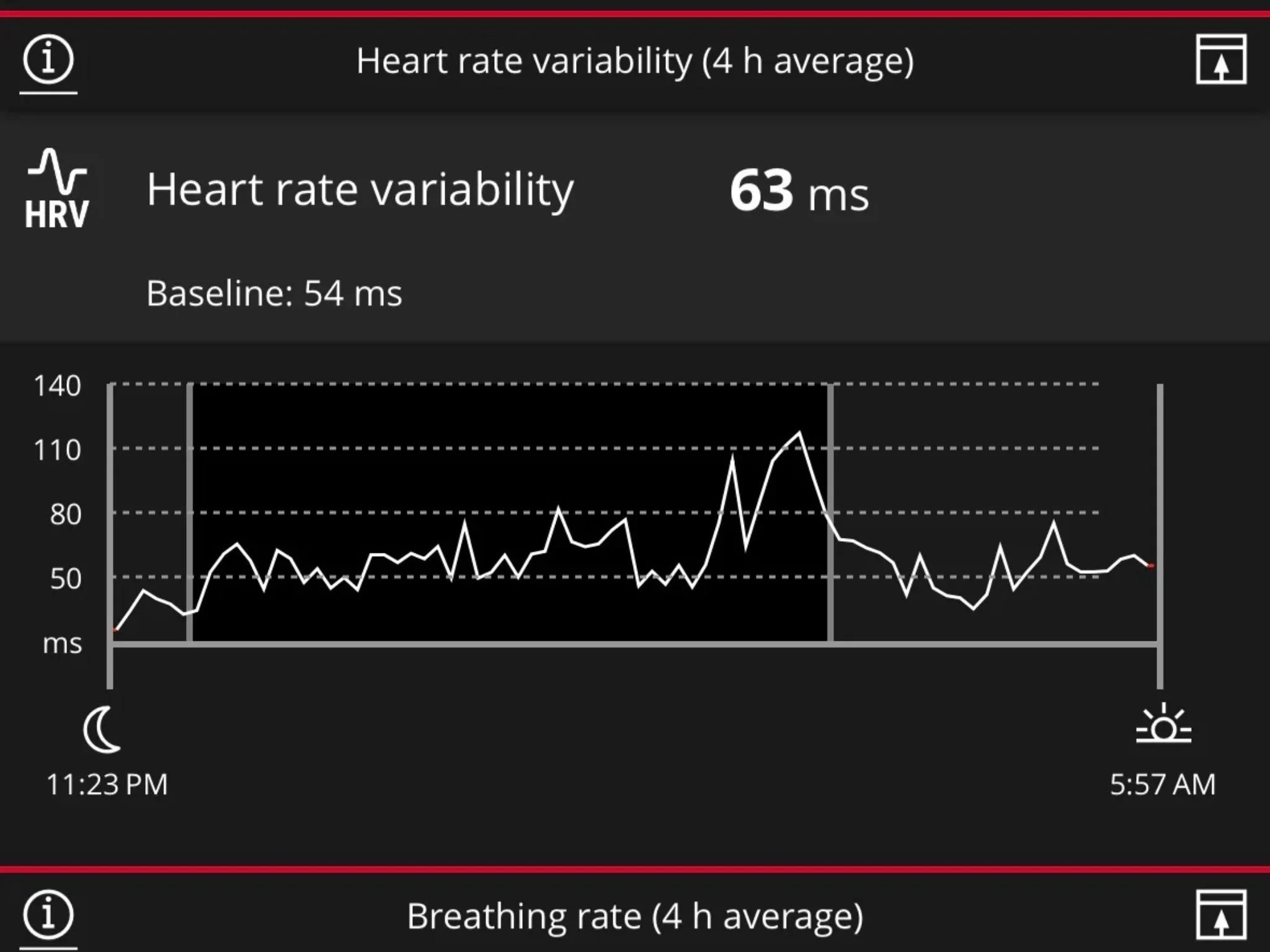
You have been wearing the device for months. Every morning it gives you a number. Some days green. Some days red. You look at it, nod, and go on with your day.
That number is your heart rate variability score. And if you do not know what it actually measures, you are missing the most useful data point your wearable produces.
This is not a wearable review. It is a physiology lesson. One that will change how you train, how you recover, and how you manage the relentless cognitive and physical demands of a high-performance career.
What HRV Actually Measures
Heart rate variability is the variation in time between consecutive heartbeats. If your heart beats 60 times in a minute, the beats are not spaced exactly one second apart. Some gaps are slightly longer. Some are shorter. That irregularity is HRV.
The variation is controlled by your autonomic nervous system, the part of your nervous system that regulates everything you do not consciously control: heart rate, breathing, digestion, stress response. HRV reflects the balance between your sympathetic system (fight-or-flight) and your parasympathetic system (rest-and-recover).
Higher HRV: Your parasympathetic system is active. You are recovered, adaptable, and ready to absorb training stress.
Lower HRV: Your sympathetic system is dominant. Your body is under load, whether that load came from a hard workout, a brutal deposition, back-to-back travel, or three nights of fragmented sleep.
Your body does not distinguish between physical stress and psychological stress. Both register as the same physiological load.
The Problem With Chasing the Number
Most people look at their daily HRV score the same way they look at a weather forecast. It is good or bad. Green or red. Go hard or take it easy.
That framing misses the point.
HRV has no universal ideal value. Your score at 54 looks different from someone at 32. Your score after a week of travel is not comparable to your score after a vacation. What matters is not the number itself. What matters is the trend.
A sustained downward trend over five to seven days is the signal worth acting on. It means your body is accumulating more stress than it is clearing. Training harder at that point does not accelerate progress. It deepens the hole.
The ACE Fitness guidance on this is direct: HRV is a monitoring tool, not a score to maximize. The goal is to understand your personal baseline and notice when you are drifting below it.
What Drives HRV Down
If you are an attorney or executive, your HRV is not just responding to your workouts. It is responding to your entire life. Here is what hammers it:
Sleep disruption. Sleep is the single most impactful factor in HRV. Even one night of poor sleep can produce a measurable drop the following morning.
High cognitive load. A day of high-stakes decisions, negotiations, or depositions activates the same stress pathways as physical exertion.
Travel and time zone shifts. Circadian disruption suppresses parasympathetic activity. Cross-country travel can tank HRV for 48 to 72 hours.
Alcohol. Even moderate intake reliably shows up in the next morning's HRV reading.
Overtraining. More volume without adequate recovery does not build fitness. It accumulates physiological debt.
The Three Recovery Levers That Actually Move HRV
You cannot force HRV up. But you can consistently remove the factors that drive it down. These three levers have the most impact for busy professionals:
1. Protect sleep architecture, not just duration.
Eight hours of interrupted sleep does not produce the same recovery as six hours of deep, consolidated sleep. HRV is restored primarily during slow-wave and REM sleep stages. Alcohol, late meals, and screen exposure before bed all fragment sleep architecture and blunt that restoration. Prioritize sleep onset before 11 PM, keep the room cool and dark, and treat the 90 minutes before bed as a decompression protocol, not a continuation of the workday.
2. Use breathwork as a fast nervous system reset.
Slow, paced breathing at five to six breaths per minute is one of the fastest known methods for shifting the autonomic nervous system toward parasympathetic dominance. Five minutes of box breathing or a 4-7-8 breathing pattern before sleep, before a session, or after a high-stress event can produce a measurable HRV response. This is not a wellness ritual. It is a physiological intervention.
3. Train the trend, not the daily number.
If your HRV trend is declining over a week, reduce training intensity. Do not eliminate training. Active recovery, Zone 2 cardio, and mobility work support parasympathetic tone. If your trend is stable or rising, that is the green light to load the system. Building this feedback loop into your training is what separates professionals who make consistent progress from those who plateau or get hurt.
What This Means for Your Training
If you are working out four or five days a week and not seeing the results you expect, your program is probably not the problem. Your recovery is.
Most high-performers have the discipline to show up. The gap is in the intelligence applied to recovery. HRV gives you a daily window into whether your body is in a state to absorb training stress or whether it needs a different input entirely.
That distinction, applied consistently over weeks, is the difference between grinding and adapting.
The Bottom Line
Your wearable is not just tracking your activity. It is tracking your nervous system's response to the total load of your life. When you understand what drives that number, you can start making decisions that actually move it.
Protect your sleep. Use your breath. Read the trend, not the daily score. And train accordingly.
If you want a clear picture of where your recovery is leaking, start with the Executive Recovery Audit. It takes five minutes and gives you a personalized read on your biggest recovery gaps.
C'mon. Let's chisel.
Source: ACE Fitness (May 2026). Using HRV to Better Understand Recovery, Resilience and Training Load. NASM (2026). Top Fitness Trends 2026.