You know the feeling. A long day of calls, contracts, and screens. You stand up at 6 p.m. and your back feels a decade older than you are. Your neck is stiff. Your shoulders are rounded forward, and they stay that way.
That is not age. It is hours of sitting in one shape.
Why Desk Posture Gets Worse Every Year
A 2025 review in the Journal of Back and Musculoskeletal Rehabilitation found that office workers spend about two-thirds of their workday sitting. For attorneys and executives, the real number is often higher.
Your spine is built to bend forward, arch back, side bend, and rotate. A desk gives it one shape: rounded forward. Hold that shape for years and your body adapts. Your chest tightens. Your mid back stiffens. Your head drifts toward the screen. Rotation quietly disappears.
Then "sit up straight" stops working. You cannot hold a position your body can no longer reach.
Here is the encouraging part. That same review found the strongest link to back pain was not total sitting time or one "bad" posture. It was sitting behavior: fewer breaks and long stretches of staying still. You may not be able to cut your hours at the desk. You can change how you move during them.
How This Series Works
The 10 stretches below are grouped into four body regions. Each one targets an area that desk work tightens most.
Every stretch has two versions:
At Your Desk: Done in your chair or standing at your desk, in work clothes, in about a minute.
Full Version: A floor-based version for home or the gym that goes deeper.
This post gives you the overview and the desk version of each stretch. Each region has its own full guide with step-by-step instructions for both versions and the coaching cues that make them work.
Safety first: Never push through pinching pain. Stop if discomfort starts during a stretch or gets worse as you move through your reps.
Region 1: Mid Back
Your mid back is built to rotate, and desk work takes that rotation away first. When it stops moving, your neck and lower back pick up the slack. A 2022 study in Medical Science Monitor found that office workers with chronic neck pain improved their neck range of motion and reduced their pain with a simple mid-back mobility routine done twice a week.
1. T-Spine Rotation: Restores rotation and gives your neck a gentle stretch. At your desk: Sit tall, cross your arms over your chest, and rotate your upper body side to side while your hips stay square.
2. Thoracic Circle: Teaches your mid back to move on its own, without your shoulders taking over. At your desk: Hug yourself and make slow, small circles with your mid back.
3. Half-Kneeling Twist: Rotates your full spine and wakes up the muscles around your shoulder blades. At your desk: Stand in a split stance, reach one arm behind you, and rotate toward your front leg.
Read the full guide: 3 Mid-Back Stretches for Better Posture at Your Desk
Region 2: Chest and Shoulders
Rounded shoulders come from a tight chest, tight lats, and sleepy muscles between your shoulder blades. These three stretches open the front of your body and reconnect you with the muscles that pull your shoulders back.
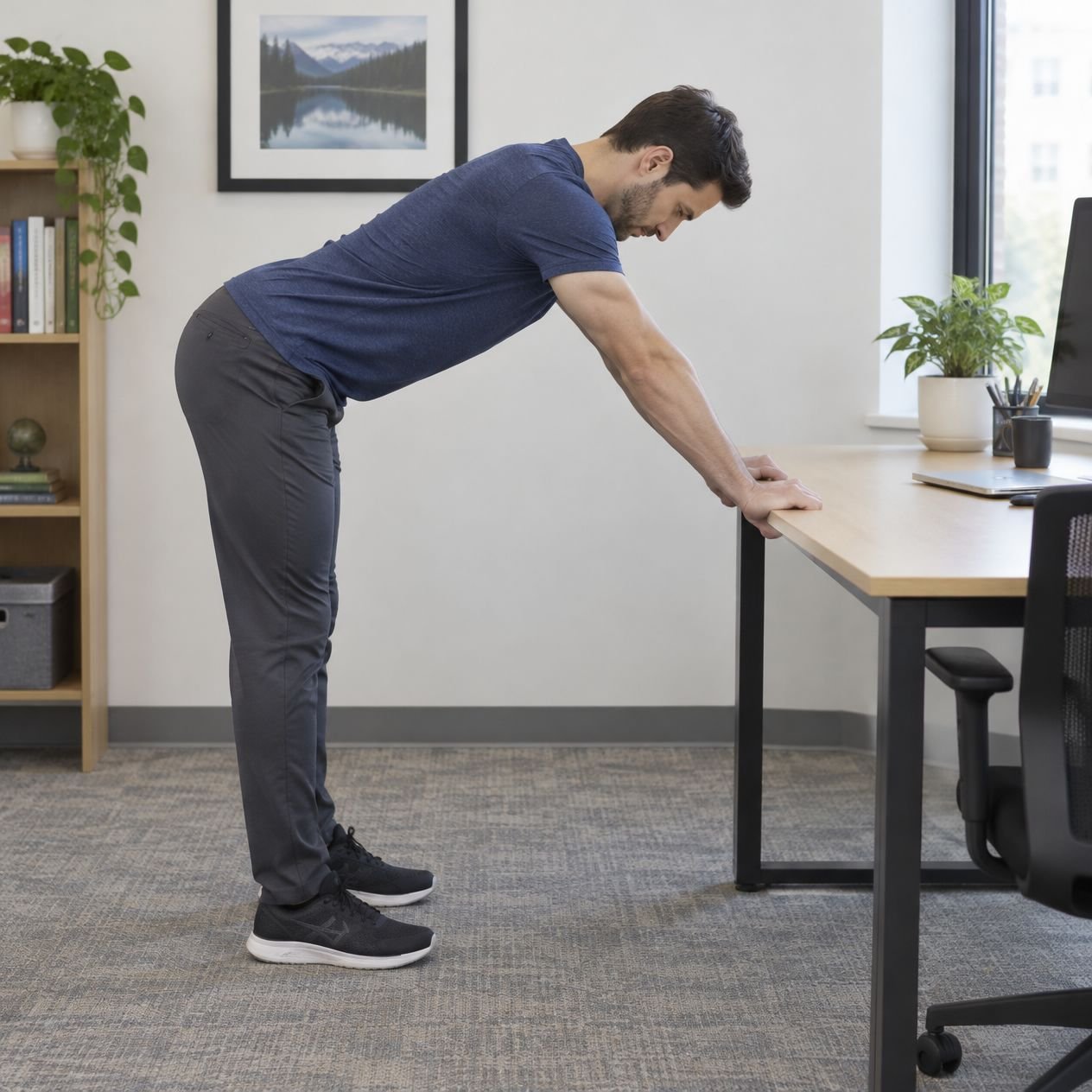
4. Prayer Stretch: Targets your lats, the large muscles that pull your shoulders forward and down when they get tight. At your desk: Rest your elbows on the edge of your desk, press your palms together, step back, and hinge at your hips until you feel the stretch along your sides.
5. Downward Facing Dog: Opens your mid back, lats, and the backs of your arms. At your desk: Place your hands on your desk with straight arms, walk your feet back, and push your hips back until your chest drops between your arms.
6. Sphinx Squeeze: Strengthens the muscles that hold good posture after the stretch is over. At your desk: Stand tall with your arms raised in a goalpost position and squeeze your shoulder blades down and together.
Full guide: 3 Chest and Shoulder Stretches for Better Posture (coming soon)
Region 3: Neck
Leaning toward a screen all day loads your neck with the weight of your head. These two stretches move your neck through every direction and open the front of your neck and chest.
7. Neck Circle: Moves your neck through flexion, extension, side bending, and rotation. At your desk: Sit tall, tuck your chin, and slowly circle your head in each direction.
8. Fish Stretch: Stretches the front of your neck and opens your mid back and chest. At your desk: Lace your hands behind your head and gently arch your mid back over the top of your chair back.
Full guide: 2 Neck Stretches for Better Posture (coming soon)
Region 4: Low Back and Hips
Good posture starts at the base. These two moves get your whole spine moving and bring your hips and breathing into the picture.
9. Cat-Cow: Flexes and extends your entire spine, one segment at a time. At your desk: Sit at the front of your chair with your hands on your knees. Arch your back and lift your chest, then round your back and tuck your chin.
10. Glute Bridge With Deep Breathing: Activates your hips and core and trains the deep breathing that supports an upright posture. At your desk: Stand tall, squeeze your glutes, and take five slow, deep breaths into your belly and ribs.
Full guide: 2 Low Back and Hip Stretches for Better Posture (coming soon)
Your Full-Body Desk Reset
Run all 10 desk versions in order and you have a complete posture reset in about 10 minutes. Start at the base of your spine and work up:
1. Seated Cat-Cow: 8 reps
2. Seated Rotation: 8 reps per side
3. Seated Thoracic Circle: 5 circles each direction
4. Standing Split-Stance Twist: 5 reps per side
5. Desk Prayer Stretch: 8 reps
6. Desk Downward Dog: 3 slow breaths, 3 times
7. Standing Goalpost Squeeze: 8 reps
8. Seated Neck Circle: 3 circles each direction
9. Chair-Back Extension: 5 reps
10. Standing Glute Squeeze With Deep Breathing: 5 breaths
Short on time? Pick the region that bothers you most and run just those stretches. Two or three minutes between meetings beats ten minutes you never get to.
Do the desk versions daily. Add the full floor versions two or three times a week alongside your strength training. Put it on your calendar like a client meeting, and protect it the same way.
Find Out What Your Body Actually Needs
Stretching helps. But posture is rarely just a posture problem. Sleep, stress, training load, and recovery all show up in how your body holds itself at the end of a long day.
The Executive Recovery Audit shows you where your recovery is breaking down and what to fix first. It takes a few minutes, and I review every result personally.
References
Alaca N, Acar AÖ, Öztürk S. Low back pain and sitting time, posture and behavior in office workers: a scoping review. Journal of Back and Musculoskeletal Rehabilitation. 2025;38(5):919-943. View study
Seo J, Song C, Shin D. A single-center study comparing the effects of thoracic spine manipulation vs mobility exercises in 26 office workers with chronic neck pain: a randomized controlled clinical study. Medical Science Monitor. 2022;28:e937316. View study