You start the day sharp. By 3 p.m., your shoulders have crept up toward your ears. Your head has drifted forward toward the screen. Your mid back feels like it is set in concrete.
That is not a willpower problem. It is what 8 to 10 hours of sitting does to the human body.
The Real Cost of Desk Posture
Your spine is built to move in every direction. It bends forward, arches back, side bends, and rotates. A desk job gives it one direction: rounded forward.
Hold that shape long enough and your body adapts to it. Your chest tightens. Your upper back stiffens. Your lats lock down and pull your shoulders forward. Rotation, the movement you almost never do at a desk, starts to disappear.
This is why "just sit up straight" never works. You hold it for 30 seconds, then slump again. Your body has lost easy access to the position. You cannot hold what you cannot reach.
The cost adds up. Neck tension. A tight chest that makes deep breathing harder. A stiff back on the drive home. A body that feels older than it is by Thursday.
A Better Way to Think About Posture
Good posture is not one perfect position you lock into all day. Your body is designed to spend time in many positions, for long and short stretches. Some positions serve a given task better than others.
The real goal is simple. Keep your body moving through its full range of motion. The more you use that range, the longer you keep it.
The three stretches below do exactly that. They are floor-based, take under 10 minutes, and need nothing more than a mat. Each one targets an area that desk work tightens most: your spine, your mid back, your chest, and your lats.
How to use them: Do these two or three times per week alongside your strength training. They also work as a daily morning reset before your first call.
Safety first: Never push through pinching pain. Stop if discomfort starts during a stretch or gets worse as you move through your reps.
1. Cat-Cow
This classic is one of the safest ways to bend and extend your entire spine. Because you are on the floor, your body has a stable base. That stability lets your spine move more freely than it can when you are standing.
Use it when your back feels stiff, or as a warm-up to wake up your spine before the day starts.
How to Do It
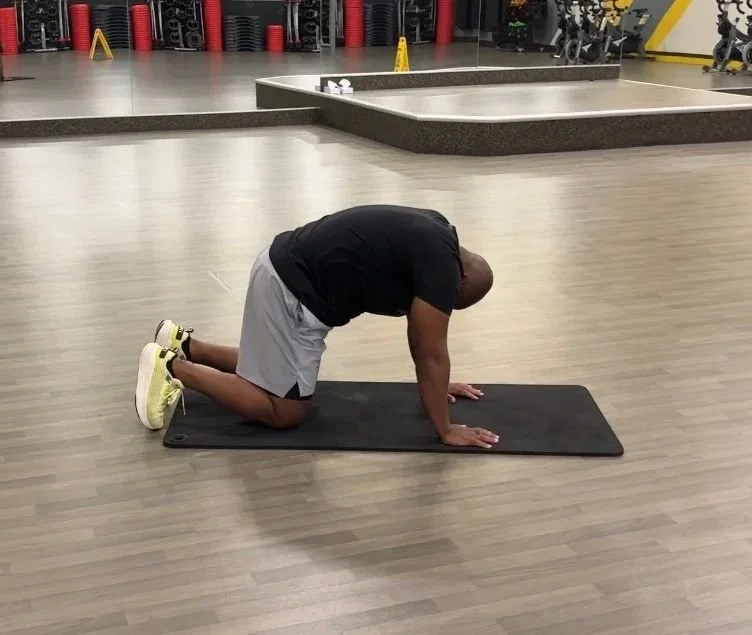
Start on all fours with your wrists under your shoulders and your knees under your hips.
Inhale. Drop your belly toward the floor, arch your back, and lift your gaze.
Exhale. Round your back toward the ceiling and tuck your chin.
Move slowly between the two positions, matching each one to your breath.
Do 10 reps in each direction. Hold each position a little longer if you want a deeper stretch.
Coaching Cue
Move one vertebra at a time. Start the motion at your tailbone and let it travel up to your head. This builds a stronger mind-body connection and shows you exactly where you are tight.
2. Side-Lying T-Spine Rotation
Rotation is the movement desk life almost never gives you. Your thoracic spine, or mid back, is built to rotate. When it stops, your neck and lower back pick up the slack.
This side-lying version restores that rotation while keeping your lower back protected. It also opens up the chest muscles on your top arm. Reach for it when you feel tension in your neck or mid back.
How to Do It
1. Lie on your side with your knees bent to 90 degrees and stacked in front of your body.
2. Extend both arms straight out in front of you along the floor, top arm resting on bottom arm. This is your starting position.
3. Slowly sweep your top arm overhead and open it toward the opposite side, rotating your spine with it. Keep your hips and legs still the entire time.
4. Circle your arm back over your body to return to the start.
5. Do 10 reps on each side. For a deeper stretch, pause longer in the open position.
Coaching Cues
• Keep your knees at hip height or higher. This locks your lower back in place so the rotation comes from your mid back, ribs, and neck.
• Follow your moving hand with your eyes. You get a bonus neck stretch.
• Breathe deeply as you open. Each breath expands your rib cage and adds to the stretch.
3. Prayer Stretch
This is one of the most effective stretches for desk posture. It targets your lats, the large muscles that run down each side of your back and attach to your upper arms. When your lats get tight, they pull your shoulders forward and down. That is the hunched shape you see at every conference table.
The prayer stretch also opens your triceps and chest and adds spinal mobility.
How to Do It
Start on all fours with your wrists under your shoulders and your knees under your hips.
Walk your hands forward until you can bend your elbows and rest your forearms on the floor.
Keep walking your hands out until your forehead rests on the floor and you feel a stretch along your lats. Your hips stay high, similar to child's pose but with your hips stacked over your knees.
Keeping your elbows on the floor, press your palms together and bend your elbows to bring your hands toward the back of your neck.
Pause for a moment.
Extend your arms to bring your hands back to the floor.
Do 10 reps. For a deeper stretch, hold each position longer.
Coaching Cues
If you cannot get into position without arching your lower back, rest your elbows or hands on yoga blocks.
Keep your hips high throughout.
Your 10-Minute Posture Reset
Put all three together and you have a complete reset for your spine:
Cat-Cow: 10 reps each direction
Side-Lying T-Spine Rotation: 10 reps per side
Prayer Stretch: 10 reps
Schedule it the way you schedule a client meeting. Put it on the calendar. Treat it as non-negotiable. Ten minutes on the floor is a small price for a body that still moves well at 60.
In the next post, we will build on this reset with three more stretches for your neck and mid back.
Find Out What Your Body Actually Needs
Stretching helps. But posture problems rarely live in one place. Sleep, stress, training load, and recovery all show up in how your body holds itself at the end of a long day.
The Executive Recovery Audit shows you where your recovery is breaking down and what to fix first. It takes a few minutes, and I review every result personally.