Your Gym Can't Do This for Your Recovery
You train hard. You eat well. You go to bed at a reasonable hour.
You still wake up flat.
Most high performers blame the program. Too much volume. Not enough rest days. The wrong split. Sometimes that's true. But often the problem isn't what you do in the workout. It's where you do it.
Think about a typical training session for a busy attorney or executive. Fluorescent lights. Recycled air. A wall of TVs running the news. Your phone in one hand, checking email between sets. Then straight back to the desk.
Your body never gets the signal that it's safe to recover.
Recovery Is a Nervous System Problem
Training is the stimulus. Recovery is where the results happen. And recovery depends on one thing more than anything else: your nervous system's ability to shift out of "fight or flight" and into "rest and repair."
For executives, that shift is hard to make. Deadlines, client calls, and constant notifications keep stress hormones elevated all day. A hard workout adds more stress on top. If nothing ever brings that load down, recovery stalls.
Sleep takes the hit next. And the cost is real. In a 2021 study in Physiological Reports, just one night of sleep deprivation cut muscle protein synthesis by 18%. Cortisol rose 21%. Testosterone dropped 24%.
One bad night. That's all it took.
The good news: one of the simplest fixes isn't a supplement or a gadget. It's a change of scenery.
4 Ways Training Outdoors Speeds Your Recovery
1. Lower Cortisol
Cortisol is your primary stress hormone. In short bursts, it's useful. When it stays high, it works against muscle repair, sleep quality, and body composition.
Nature brings it down. Researchers at the University of Michigan tracked people who took regular "nature pills" over eight weeks. In this 2019 study in Frontiers in Psychology, salivary cortisol dropped 21.3% per hour beyond its normal daily decline. The most efficient dose was just 20 to 30 minutes.
The takeaway: A 30-minute park workout gives you a training session and a nature dose at the same time.
2. Faster Switch to Rest and Repair
Your heart rate variability (HRV) is one of the best windows into recovery. Higher HRV means your parasympathetic nervous system, the "rest and repair" side, is in control.
Green space pushes you in that direction. A study across 24 forests in Japan compared 280 participants in natural settings versus city settings. In nature, participants showed lower cortisol, lower pulse rate, lower blood pressure, greater parasympathetic activity, and reduced sympathetic activity.
The takeaway: If you track HRV, compare your readings the morning after an outdoor session versus an indoor one. The numbers will tell you.
3. Better Sleep Tonight
Your body clock runs on light. Indoor lighting is far dimmer than daylight, even on a cloudy day. That weak signal leaves your internal clock drifting later, which makes it harder to fall asleep at night.
A 2013 study in Current Biology sent participants camping for a week with only natural light. Their internal clocks shifted about two hours earlier and lined up with sunrise and sunset.
Better timing means better sleep. And as the sleep research above shows, better sleep means better muscle repair and a healthier hormone profile.
The takeaway: Train outside in the morning when you can. Daylight early in the day anchors your clock for the night ahead.
4. Less Mental Fatigue
Recovery isn't only physical. A drained mind makes the same workout feel harder and makes it easier to skip the next one.
"Green exercise" helps. An analysis of 10 studies and 1,252 participants, published in Environmental Science and Technology, found that the biggest improvements in mood and self-esteem came in the first five minutes of exercising in nature.
Five minutes. Not an hour.
The takeaway: Leave your phone in airplane mode. Let the environment do its job. You'll walk back into your next meeting sharper than when you left.
How to Build a 30-Minute Park Session
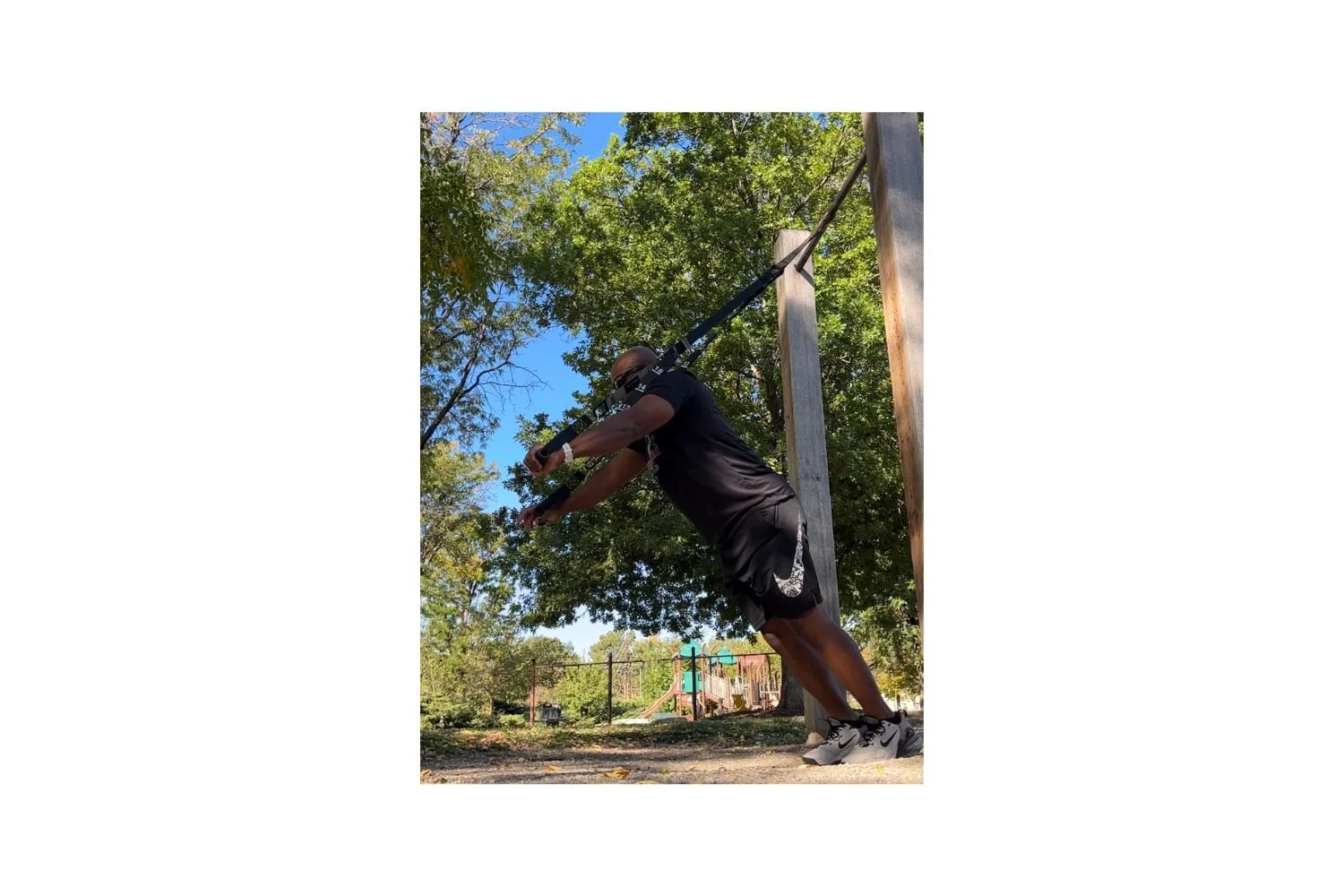
You don't need a gym to train hard outdoors. A TRX suspension trainer, a set of exercise bands, and a park bench are enough to run a full-body circuit.
Here's the structure I use with clients. Alternate upper body and lower body exercises with almost no rest. This is called Peripheral Heart Action training. It keeps your heart rate elevated while each muscle group recovers.
TRX chest press: 15 reps
TRX squats: 15 reps
Band lat pulldowns (anchored high): 15 reps
Lateral step downs: 15 reps
Band overhead press (standing): 15 reps
Single-leg calf raises: 15 reps per leg
Move from one exercise to the next with minimal rest. Rest 60 to 90 seconds after each round. Complete 3 to 4 rounds.
A few ground rules to get the full recovery benefit:
Go early. Morning daylight does the most for your body clock.
Unplug. Phone on airplane mode for the full session.
Stay consistent. Two or three outdoor sessions per week is a practical target.
Stay close. Set up near the bench so transitions stay under 15 seconds.
Where Is Your Recovery Leaking?
Outdoor training is one lever. But most executives have more than one recovery leak. Poor sleep timing. Chronic stress. Training that doesn't match their schedule.
The Executive Recovery Audit shows you exactly where your recovery is breaking down and what to fix first. It takes a few minutes, and it's built for people who don't have time to guess.